How to Deploy AI Agents in a Business Without Losing Control
فارسی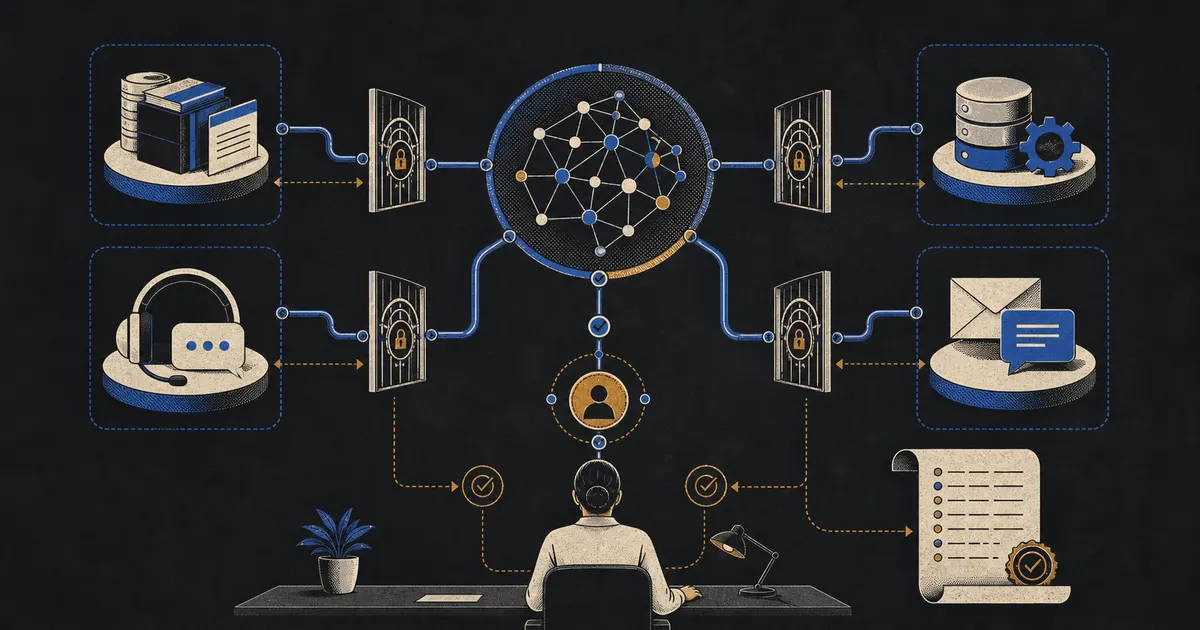
The short answer: do not begin by giving an agent access to everything. Choose one bounded, repeatable workflow, define a measurable outcome, expose only the tools needed for that job, and place human approval directly before sensitive actions. Test ordinary and adversarial scenarios, record every consequential action, and expand autonomy only when production evidence supports it.
In 2026, the important shift is not merely that models write better answers. Agents take longer delegated tasks, move across tools, and can change real systems. OpenAI’s research on how agents are transforming work describes this move from short chatbot interactions toward longer-horizon delegated work. Once output can become an email, CRM update, refund, file change, or customer commitment, model quality is only one part of reliability. The operating design around the model becomes the product.
Choose the workflow before the model
A strong first workflow has clear inputs, a repeatable output, observable success, and recoverable mistakes. Ticket classification, response drafting, contract-field extraction, a post-approval CRM update, or a daily operations report are better starting points than a mandate to automate the entire company.
Evaluate a candidate workflow with four questions:
- Are the input and expected outcome specific and repeatable?
- Can errors be detected and reversed?
- Can success be measured through time, quality, resolution rate, or human corrections?
- Can data and tool access be limited to a small surface?
The first objective is controlled usefulness, not maximum autonomy. A moderate-value, reversible task produces better learning than a financially or legally consequential workflow whose failure modes are still unknown.
Write an authority map on one page
Before connecting an API or MCP server, document what the agent may read, propose, execute, and escalate. OpenAI’s Presence announcement frames enterprise deployment in similar terms: start with a specific job, connect only the necessary knowledge and systems, establish permissions and policies, evaluate behavior, and define when people take over.
Give each tool three possible levels:
- Read: search knowledge, retrieve a record, or inspect status.
- Propose: create a draft or suggested change without an external side effect.
- Execute: send, modify, delete, pay, publish, or create a commitment.
Most integrations should begin at read or propose. Automatic execution becomes reasonable only when inputs are structured, outcomes are reversible, blast radius is bounded, and measured error rates are acceptable.
Enforce least privilege in infrastructure
A prompt that says “only do authorized work” is not a security boundary. Use a dedicated service account with narrow, revocable permissions. An order-status agent does not need a refund endpoint or bulk customer export. A project agent should not inherit an entire drive.
OWASP describes excessive agency as a distinct risk in LLM systems: when a model can invoke functions with disproportionate impact, ambiguous input, model error, or prompt injection can become a damaging action. Practical controls include scoped credentials, tool allowlists, parameter validation, rate and amount limits, environment separation, and a tested kill switch.
Put human approval immediately before the side effect
Approval hidden at the end of a long report becomes ceremony. The approval surface should appear before the exact sensitive tool call and show the decision context: the intended action, target record, relevant data, reason, and likely effect.
The OpenAI Agents SDK documents a pause–approve–resume pattern. Execution stops before an approval-gated tool, pending state can be persisted, and the run resumes after a person accepts or rejects the action. This pattern is appropriate for public sending, deletion, moving money, scheduling commitments, permission changes, and sensitive-data handling.
Do not gate every harmless read. If people must approve routine search calls, they learn to click without thinking. A good approval boundary is infrequent, legible, and proportional to risk.
Evaluate scenarios, not impressive conversations
A convincing demo is not deployment evidence. Build an evaluation set that includes:
- ordinary high-frequency requests;
- missing, contradictory, or stale information;
- the wrong user or target record;
- requests outside policy and attempts to bypass it;
- API outages, timeouts, duplicate responses, and retries;
- cases where the correct behavior is to stop or escalate.
Score more than prose quality. Measure the final outcome, tool selection, arguments, policy compliance, approval behavior, and escalation decision separately. The site’s AI agent evaluation framework provides a broader acceptance model, while the Persian AI evaluation-set guide shows how localization becomes testable rather than anecdotal.
Make the action trail reconstructable
Raw technical logs are not enough. For each run, an operator should be able to reconstruct the effective instruction and model versions, retrieved knowledge, tool calls, redacted arguments, human decisions, destination-system read-back, and errors. Do not place sensitive payloads in traces by default; controlled identifiers and summaries often provide sufficient observability with less privacy exposure.
Separate three operational views: outcome quality, risk and exceptions, and cost and latency. A high human-escalation rate is not automatically failure during an early rollout; it can show that boundaries are working. The metric to reduce is low-quality escalation without useful context.
Release autonomy in stages
- Shadow mode: generate results without external effects and compare them with human decisions.
- Draft mode: present proposed messages or changes to an operator.
- Approved action: execute sensitive operations only after explicit approval.
- Bounded autonomy: automate a narrow class of low-risk actions with limits and rollback.
Define an exit gate for every stage: sample size, zero critical policy violations, quality above a stated threshold, tested rollback, and a named service owner. When a policy or destination system changes, rerun the affected evaluations.
A 12-point production checklist
- One specific job and measurable outcome are defined.
- Out-of-scope behavior is documented.
- A dedicated least-privilege identity is in use.
- Tools and arguments have allowlists.
- Sending, deletion, payment, and commitments require appropriate approval.
- Timeouts, retries, and duplicate prevention are designed.
- Ordinary, edge, and adversarial scenarios have been evaluated.
- Prompt, policy, and tool-schema versions are recorded.
- Traces avoid unnecessary sensitive data.
- Rollback and credential revocation have been tested.
- A human owner and escalation path are named.
- More autonomy requires evidence, not demo excitement.
Design for provider and regional resilience
Do not couple the operating policy to one irreplaceable provider. Before adoption, verify current regional availability, payment and contractual terms, data location, trace export, and an exit path from official sources. Keep tool and policy layers as portable as practical so a model or provider change does not require rebuilding the control system.
Conclusion
A safe agent is not a less capable agent. It is an agent whose authority grows with evidence. Start with one bounded workflow, enforce permissions below the prompt layer, place approval before sensitive effects, evaluate realistic scenarios, and keep actions observable and reversible. For the engineering side of the same discipline, see the safe agentic coding workflow.